Land Acknowledgement
I would like to acknowledge that I currently reside on the unceded and unsurrendered homelands of the Michi Saggig Nishnaabeg. My work as an artist includes places and spaces across the province of Ontario including the shorelines of Lake Ontario, Muskoka River and Rideau River which is home to many First Nation Communities. I want to acknowledge my place as a settler connecting to these lands and waterways for many Nations. As a settler, I will continue to reflect on what it means to reside on these lands and how my identity and experiences shapes my relationships and responsibilities to these lands.
About the Artist
Wendy Wallace is a graduate of the University of Toronto, Sheridan College, and the University of Ontario. She has received grants from the Ontario Arts Council and Canada Council for the Arts supporting education and independent artistic creation. In 1985, she received a scholarship to the Banff Centre School of Fine Arts, where she completed an independent study.
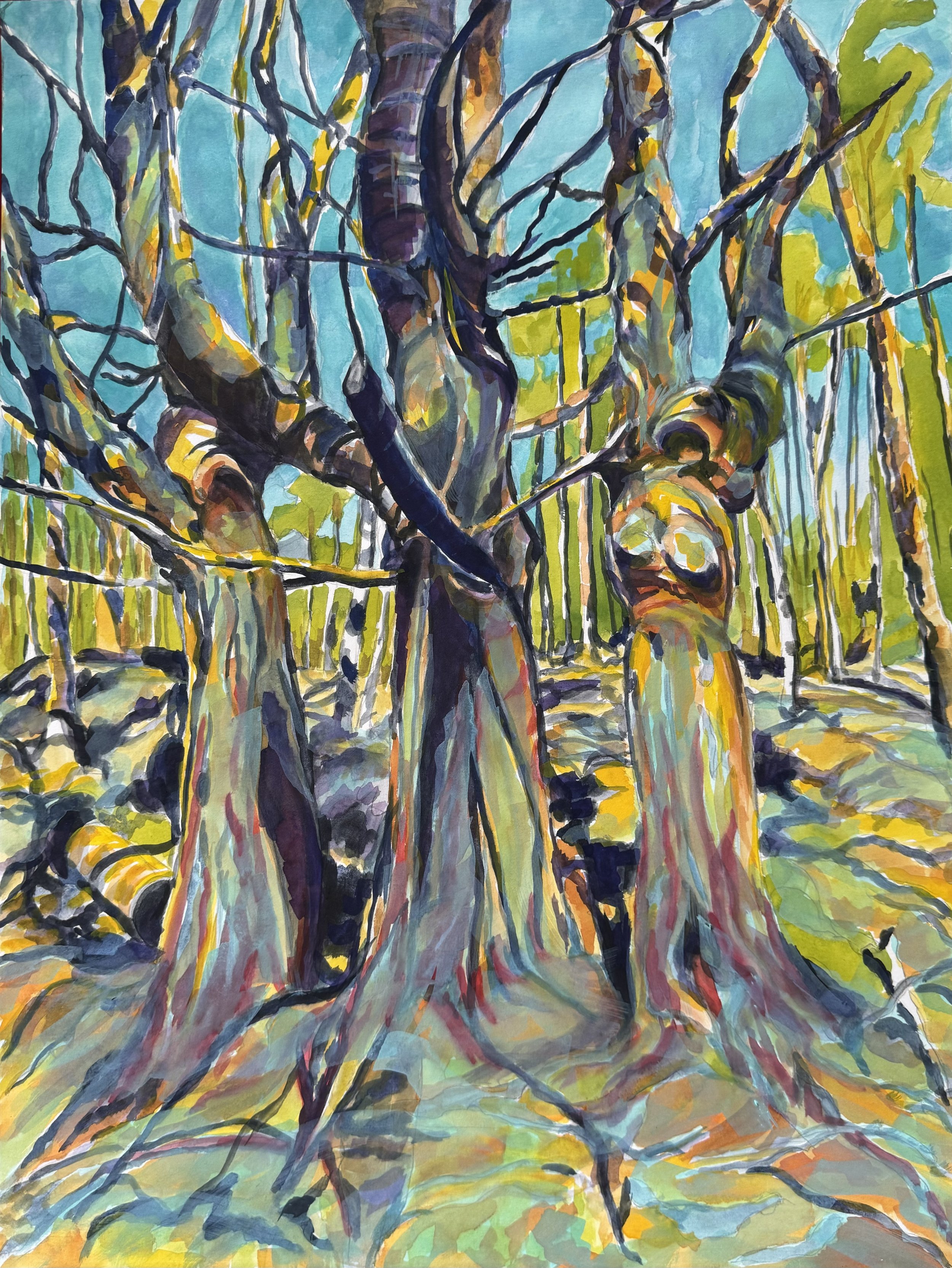
Her work has been exhibited in numerous solo and group exhibitions and is held in public and private collections. Since 2023, Wallace has returned to her studio practice, using photography as an integral part of her painting process to explore transformation and transition within the landscape. Drawing from lived experience, Wallace explores landscape as a cultural symbol shaped by memory, history, human presence, and the natural environment, bringing forward the emotional and human dimensions of our relationship with the land.
“I choose subjects based on my observations in the places and spaces I travel through, constructing compositions from experiential reality. The paintings are perceptions of change that have altered the environment, bringing to mind the interconnectedness of people, trees, water, land and architecture revealing narratives and stories in the landscapes of southern, central and eastern Ontario. Overall my images encompass my experiential connections in nature, becoming perceptions of humanized cultural narratives merging memories of the land with the present.”